
On this page:
New to practice notes?
Planning practice notes give technical advice about the planning system, each dealing with separate aspects of the system.
This practice note should be read alongside Planning Practice Note 91: Using the Residential Zones.
The importance of planning for housing
To meet its housing needs, Victoria requires 2.24 million more homes by 2051. Housing targets set out where these 2.24 million homes are expected to be accommodated in each municipality. The targets give a clear direction for planning authorities to plan over the long term and ensure planning schemes can accommodate Victoria’s future housing needs.
The Planning Policy Framework (the PPF) is part of all planning schemes in Victoria and sets out the context for spatial planning and decision making. It includes state, regional and local planning policies and, among other things, it sets out a planning authority’s obligations in relation to planning for increased housing to meet the housing targets.
Key PPF housing and settlement policies to be considered are:
- Clause 11.01-1S Settlement
- Clause 11.02-1S Development capacity
- Clause 15.01-5S Neighbourhood character
- Clause 16.01-1S Housing supply.
The PPF requires planning authorities to:
- Plan to accommodate housing targets and provide clear direction on the locations where growth should occur and ensure sufficient realisable capacity in planning schemes
- Ensure ongoing development opportunities and supporting infrastructure are available to support sustainable urban development.
The PPF also requires planning authorities to consider region-specific objectives and strategies.
Serviced urban land within settlement boundaries, such as the Urban Growth Boundary, is limited. To avoid further urban sprawl, planning authorities need to plan for increased housing in established areas. This includes more housing across all locations within settlement boundaries, with priority given to well serviced areas like activity centres, regional cities and centres with access to public transport, jobs, community facilities and other services. These areas also have potential to support additional low to mid-rise apartments and townhouses alongside existing houses in walkable catchments around these well serviced areas.
When planning for housing, planning authorities must also consider environmental, social, and economic factors, including special characteristics like heritage, neighbourhood character and landscape significance. Competing polices should be balanced in favour of net community benefit and sustainable development.
Planning for housing involves both strategic planning and statutory implementation to ensure policy objectives can be met. This practice note focuses on strategic planning for housing. Planning Practice Note 91 focuses on statutory implementation when planning for housing.
Strategic planning for housing
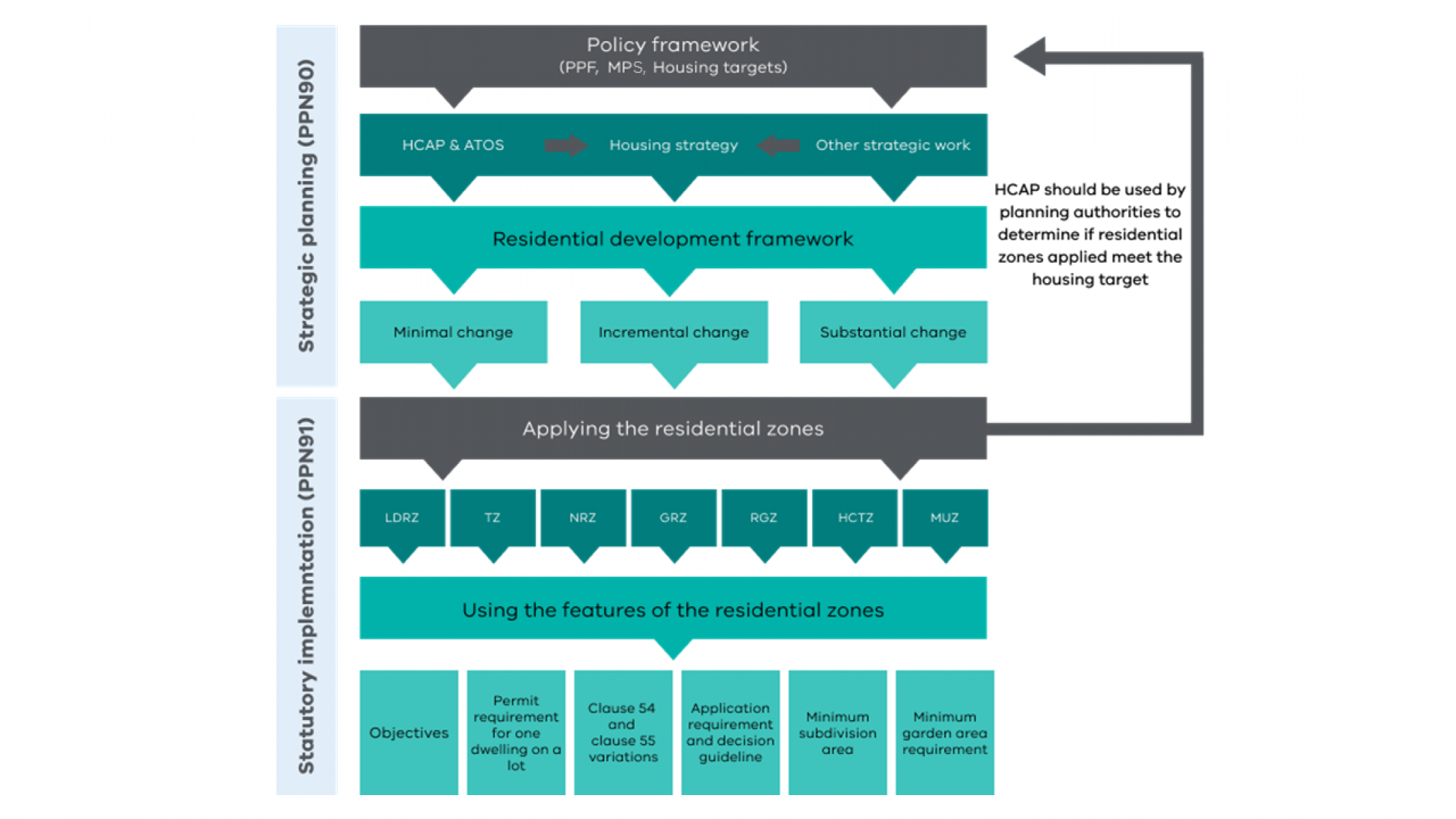
Strategic planning for housing should plan holistically for housing change. Figure 1 shows the broad requirements to:
- Implement the PPF, especially to consolidate, redevelop and intensify established urban areas, and areas within settlement boundaries, to ensure housing targets can be met.
- Integrate broader housing strategy with other strategic work informed by the Department of Transport and Planning’s Housing Capacity Assessment Platform (HCAP) that provides a state-wide consistent way of estimating the capacity of planning schemes.
- Develop a clear residential development framework that identifies:
- A range of housing opportunities across the municipality to meet the 2051 housing targets specified in the PPF, as informed by HCAP.
- Substantial change areas with good access to jobs, public transport and community facilities.
- Incremental change areas.
- Minimal change areas where environmental constraints and landscape significance applies.
- How the conservation of special characteristics like heritage and neighbourhood character will be balanced with the need to meet housing targets with well-located homes.
Housing strategy
In preparing a residential development framework, a planning authority would normally develop a housing strategy. Developing a housing strategy should follow the broad steps outlined in Plan for Victoria. These strategic plans need to be managed as living plans and their implementation should be monitored.
To understand local issues a planning authority should engage with the community and other stakeholders when preparing a housing strategy. A housing strategy should be informed by a clear analysis of demographic trends, housing supply and demand data, and information about local land-use opportunities and constraints.
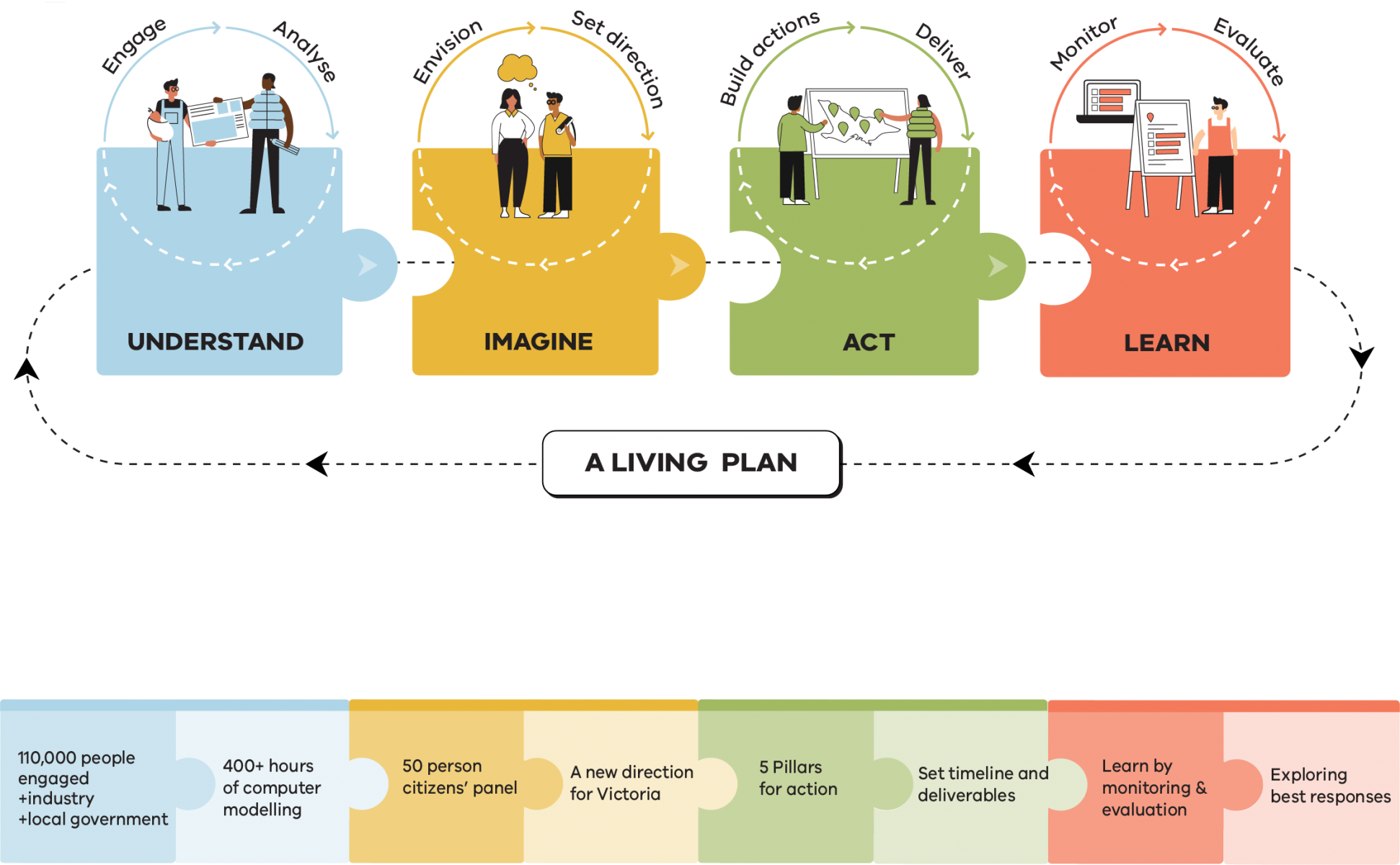
A housing strategy may also consider how planning authorities can deliver more diverse and affordable housing, align growth with existing and future infrastructure, provide better access to jobs, services and open space, and enhance local attributes.
Creating a residential development framework
A residential development framework provides a means to balance competing strategic objectives to enable a planning authority to plan for housing change and to meet its housing target obligations under clauses 11.02-1S and 16.01-1S of the PPF.
A residential development framework should bring all the strategic work together into a coherent strategic vision and identify the housing change that will take place in different areas.
Housing Capacity Assessment Platform
HCAP supports planning authorities to estimate housing capacity under different residential zoning scenarios. HCAP outputs will inform the extent to which municipalities have achieved the housing target specified in the PPF. Using HCAP ensures a consistent approach to measuring planning scheme capacity across municipalities. HCAP is designed for use by the Department of Transport and Planning (DTP) and local government strategic planners. Access to HCAP is provided through DTP at planforvictoria@transport.vic.gov.au.

Access to Opportunities and Services
The Access to Opportunities and Services (ATOS) tool is incorporated into HCAP and provides information about public transport access and the location of jobs and community facilities and services (such as supermarkets, medical services and open space). ATOS should be used to identify areas where housing change is to be prioritised.
ATOS provides a ‘score’ based on the level of access for a given location. A higher score will indicate the area is more suitable for housing change.

| ATOS score | Level of access (suitability for housing change)* |
|---|---|
| A1 | High (very strong, excellent) |
| A2 | Medium-High (strong, above average) |
| B | Medium (moderate, average) |
| C | Medium-Low (below average) |
| D | Low (weak) |
| E | Very Low (minimal) |
Identifying change areas
One of the key tasks of a residential development framework is identifying housing change areas.
The starting point when planning for change should be the identification of areas with good access to opportunities and services by using ATOS. This should inform strategic planning work for identifying housing change areas of minimal, incremental and substantial change through a residential development framework. Change is relative to its context and the existing built form of an area should be considered.
Identifying housing change areas also provides certainty to the community about where growth and intensification will occur, or where environmental constraints or special characteristics mean that housing change will be more limited.
A framework for managing change typically comprises the delineation of minimal, incremental and substantial change areas. A greater breakdown of housing change areas may be acceptable if there is a strong strategic basis for the approach and the additional housing change areas clearly reflect preferred development outcomes. The type of change being sought should broadly fall within the boundaries of the broader minimal, incremental and substantial change categories.

Substantial change areas
Substantial change areas are where housing intensification will occur. These areas will result in a substantially different scale and intensity of housing compared to other areas of a municipality. This includes areas prioritised for housing change such as activity centres, central activity areas of regional cities and centres, and strategic development areas.
Substantial change areas usually have a medium to high ATOS score of A1, A2 or B.
Substantial change areas will reflect a different degree of change in different built form contexts. For example, a substantial change area in an outer urban and regional context may more closely resemble an incremental change area in an inner urban context.
Substantial change areas:
- are close to jobs, public transport and community facilities and services (medium to high ATOS score)
- facilitate housing growth that takes advantage of their proximity to jobs, services, and public transport
- make the most of strategic development areas or opportunity sites
- promote housing diversity
- result in a new built form.
Incremental change areas
Incremental change areas:
- are where housing growth occurs within established settlement boundaries
- do not have environmental constraints or special characteristics
- are not prioritised for substantial housing change such as in activity centres, central activity areas of regional cities and centres, and strategic development areas
- usually have a low to medium ATOS score of B, C, D or E.
The built form context of incremental change areas can vary widely. For example, incremental change in an inner urban area can represent a very different scale of development from an incremental change area in an outer suburban area, or a regional town or city.
The key point is that incremental change is relevant to its context.
Incremental change areas:
- have capacity for housing growth and more diverse types of housing
- are close to jobs, services, facilities or public transport (low to medium ATOS score)
- are where existing neighbourhood character will evolve and change over time with reference to the key identified neighbourhood attributes.
Minimal change areas
Minimal change areas have characteristics that are ‘sufficiently special’ to a municipality, metropolitan Melbourne or Victoria, and should be protected because of their special neighbourhood, heritage, environmental or landscape characteristics.
Minimal change areas can also be areas that are constrained by the physical capability of the land to safely accommodate more residential development. For example, areas close to airports, land subject to bushfire risk, flooding or erosion.
Minimal change areas should not be based solely on a low ATOS score. While a relevant consideration, accessibility is only one factor to consider when determining an appropriate strategic response to relevant state, regional and local settlement, housing and other planning policies. Minimal change areas may have a high or low ATOS score.
As part of identifying minimal change areas, a planning authority should consider whether:
- Protecting identified characteristics in the area may:
- unduly constrain the provision of housing in an area with a high ATOS score.
- have an impact on the provision of housing in other parts of the municipality, to meet the municipal housing target.
Minimal change areas may appear differently in different built form contexts. For example, inner city heritage terraces and large lots with landscape values may both be considered minimal change areas but are very different residential environments. In both cases, the special characteristic of each area is the principal input into whether they are categorised for minimal change.
Minimal change areas:
- have special characteristics that distinguish them from other parts of the municipality or surrounding area
- have special neighbourhood character, heritage, environmental, or landscape significance identified in the planning scheme
- are unsuitable for providing future housing growth
- tend to have overlays that reflect neighbourhood character, heritage, environmental or landscape significance or other physical constraints which may impact their capacity for change.
Gumnut Residential Development Framework Plan

Implementing a residential development framework
The PPF and the MPS form the strategic foundation of a planning scheme and provide the basis for the application of requirements through zones and overlays to give effect to identified planning outcomes in a residential development framework.
The role of the Municipal Planning Strategy
The MPS outlines the planning outcomes the municipality seeks to achieve that will be implemented by the policies and requirements of the planning scheme.
If a planning authority only wishes to rely on the MPS to provide local strategic direction for housing it should contain:
- an overarching vision and strategic directions for the built environment and housing outlining how housing targets will be met
- a municipal-wide strategic framework plan or inclusion of a separate residential development framework plan identifying housing change areas
- delineation and description of desired outcomes for each housing change area.
The MPS can be complemented by local housing and other policies.
It may be enough to use the MPS in conjunction with state and regional planning policy to successfully implement a residential development framework and not include local planning policy in the PPF.
This will depend on whether the key strategic directions can be sufficiently expressed through a map or maps showing housing change areas and policy statements for these housing change areas within the MPS only.
The PPF and role of local planning policies
The PPF is the single integrated policy content of a planning scheme and provides a context for spatial planning and decision making by planning and responsible authorities.
A local planning policy complements state and regional planning policy by setting out the strategic basis for the application of a provision and, where appropriate, guides the exercise of discretion under that provision.
Where it is necessary to use a local planning policy in addition to the MPS to implement a residential development framework, the relevant sub-clauses of clauses 11 and 15 should be used.
The locations of housing change areas do not need to be described. A map should be used instead.
Any matters that relate to the exercise of discretion in housing change areas should be included in local planning policy.
Using maps
Maps should be used to provide visual expression of a residential development framework. This could be mapped through a municipal-wide strategic framework plan or inclusion of a separate residential development framework plan identifying housing change areas.
A residential development framework in the MPS may include more than one map if a single map cannot legibly contain the necessary information.
Additional maps in the planning scheme that identify environmental constraints or special characteristics must align with the residential development framework.
Disclaimer
This publication may be of assistance to you but the State of Victoria and its employees do not guarantee that the publication is without flaw of any kind or is wholly appropriate for your particular purposes and therefore disclaims all liability for any error, loss or other consequence which may arise from you relying on any information in this publication.
Page last updated: 28/01/26